Showing posts with label Essay. Show all posts

Friday, 17 July 2020

The Perfect Trilogy?

Recently I have completed a portion of my big 2020 re-read in finishing my re-reads of A Game of Thrones, A Clash of Kings, and A Storm of Swords. I've come away from that more in love with the series than I was before, but I also came away wondering something. Were the first three novels a perfect trilogy?

In the original pitch for this series, Martin declared he was going to be writing a trilogy for a A Song of Ice and Fire, and we know how well that turned out. He did fairly rapidly complete the first three installments between 1996, 1998 and 2000, with a five year gap between ASOS and A Feast for Crows, a six year gap between it and A Dance With Dragons and a ???? gap between it and The Winds of Winter. The issues with A Feast for Crows and A Dance with Dragons I intend to address later, after my mammoth reread of A Feast with Dragons. For now though, I'm going to examine the first 'trilogy' as it were.

Having been completed within only two years of each other, the first three books do end up feeling very tightly paced. The same characters are almost omnipresent in each novel (save for the introduction of new view points later in ACOK and ASOS) but each adds more to the plot than they might detract. Overall the same characters telling the same story. ASOS is where this begins to diverge, but not as much as you might think.


Going forward I want to express that yes these aren't a perfect trilogy, there are too many loose ends, but I do think that the narrative is concise and well plotted directly to the end. It ends the first 'arc' of the series if you will.

To begin with, we have the grand opening to the series which is masterfully crafted at Winterfell in AGOT. We are, after the fabulous prologue, introduced seriatim to the major point of view characters, establishing important relationships, the setting, and the interplay between the plots in Westeros in Essos in a very compact and even handed manner. With the exception of the introduction of Davos and Theon in ACOK which counterbalances the loss of Ned's POV, we don't have many new viewpoint characters until Sam and Jaime counterbalances the loss of Catelyn in ASOS and Theon disappears from the story until ADWD.

Between these three books there's some remarkable continuity in both the scope of the plot and the range of the characters. Dany, for instance, is our only voice on Essos until well into AFFC or ADWD, and carries that portion of the story from Pentos to Slavers Bay when people begin to drop off Westeros in drips and drabs. Then in Westeros itself we have a stable cast of characters until the end of ASOS. They, broadly speaking, tell the story of the War of the Five Kings from top to bottom, until it can be said to peter out by the end of ASOS. 

In miniature it can be said that this trilogy tells the tale of the Northern War for Independence, the Rise of House Lannister, the war between the Night's Watch and the Wildlings, with the creeping threat of the Others ever present, and the rise of The Prince That Was Promised. These four threads are both, directly in the narrative and then in the background, sprinkled throughout with background characters and other relationships between them. Selmy in the first book to his appearance with Dany on Qarth being an example of a character who provides important background plot advancement. Varys being the ultimate example of that.

To argue specifically for each of these overarching plots:

The War for Northern Independence (itself a sub plot of the War of the Five Kings) is set off by the execution of Ned Stark by Joffery. This causes a sudden shift in Northern war aims, and Rob Stark is crowned king. This is what ends AGOT and picks up in the next two installments, with Rob's battles and campaigns coming to the forefront or the background across the next two installments. These all culminate in the Red Wedding half way through ASOS, where the king is dead and we discover Roose Bolton is to become Warden of the North and supplant House Stark. Now there's the outliers like the sieges of Riverrun and Raventree Hall, but even Tywin rightly points out that with so many highborn hostages, it's all over but the kneeling. So this is one plot that comes to a dark but satisfying conclusion in ASOS, but which leads into one of the other plots which I'll address in a moment.

This second plot thread is about the Rise of House Lannister. This one is, I admit, a bit more nebulous, but it is conveyed through the eyes of Tyrion and Sansa (and to me this has a nice bit of imagery with their forced wedding) as we see in the background Tywin making very profitable marriages. Whether it was the pre-series marriage of Cersei to Robert, or the gaining of lands by marrying Tyrek to Ermesande Hayford or the awarding of Lacel Lannister the lands of the extinct House Darry, these are all small steps. Each is a small move to take a bite out of one portion of Westeros and put down Lannister roots to establish Lannister rule. This continues with Joffery and then Tommen's marriage to Margery Tyrell, and with Tywin's plans to marry Cersei off to someone. Arguably it reaches its apogee just after the Purple Wedding, only for the set up to come crashing down when Tyrion shoots Tywin with a crossbow and Cersei attempts to take charge.

The war between the Night's Watch and the Wildlings is pretty self-explanatory I think. Just to recap, the events of AGOT directly set up Mance Rayder's attack on the Wall in ASOS and in so doing sowed the seeds for the end of that direct military conflict, but not the peace, which is one of those dangling plot threads left over for later. 

Finally we have the rise of the Prince That Was Promised with Dany. Her whole arc is in many ways, messianic. From braving the flames to her dragons hatching with a cosmic portent overhead in AGOT, braving the desert and then the temptation of devils in Qarth in ACOK, to finally accepting her role as a queen in ASOS but perhaps refusing the call, when she decides to settle down in Mereen. This one is, aside from Bran's arc, one of the most magical in the whole series, with dragons, warlocks, wizards, and quests galore. She goes from being a beggar, to having the only living dragons in the known world. Added to that the not unreasonable speculation she is that promised "prince" with her 'birthing' the dragons in fire and blood and being a direct descendant of Aegon's line, it's not unreasonable to see these first three novels being about her acceptance of her role as a ruler before settling into the Meereenese Blot at the end of ASOS.

Like I said before, these are not perfect points, or even endings. They quite notably don't say anything for Bran, Sansa, or Arya's plot arcs. And I admitted up front that this was an imperfect analogy. However, that being said, I would argue that ASOS can be considered to wrap up these important plots and narrative arcs which directly set the stage for later events.

Some of those dangling plots are of course the emerging War in the North, the Meereenese Blot, the Three Eyed Crow and Arya and her identity, Sansa and Davos, among others. However, their stories all either have dramatic endings or set up the major narratives for later. 

Sansa for instance at last escapes King's Landing. Arya leaves Westeros and begins her journey down the nebulous well of identity. Bran makes it beyond the Wall. Finally Tyrion is being set up for greater things, some of which remain a bit mysterious.

The introduction of new characters, secondary plot points, and other regional issues (like Dorne) in AFFC and ADWD may explain the frustration some readers had with those novels. It could be reasonably said that unlike these first three books, where entire narrative arcs either conclude or are set up for their next steps, these two books introduce more but end less as the reader is essentially left in limbo.

Now, because of that very limbo, I do feel that I can reasonably conclude that the first three books are a great narrative trilogy, inasmuch as they establish the next phase of the story. They have tightly plotted and well developed character and narrative arcs which drive the story forward and give us satisfying next steps for our principle cast. AGOT is our beginning, and ASOS is our end. To borrow from another series, it is not the ending, but it is an ending. 

For now, it's probably the most satisfying narrative conclusion we have in this series until the final words are typed in A Dream of Spring.

Thursday, 30 May 2019

Show Ends Book Ends Not the Same

This last Sunday was the first Sunday in quite a long time where people didn't get to hum along to the most catchy theme music in fantasy for a while. Yes, Game of Thrones has finally come to an end. What an end that was though. Wherever you stand on it, just let me get something out of the way;

The books will not end the same as the show. The idea that it will is sheer madness.

Since the very divisive ending of the show, it seems there has been something of an uptick in people speculating how close the show ending will come to the book ending. The short version is, not very close really, the longer version is below.


First however, let us get something out of the way, what does the author say about it. Well, GRRM on his Not a Blog website, says surprisingly little. Here is exactly what he said:
How will it all end? I hear people asking. The same ending as the show? Different? 
Well… yes. And no. And yes. And no. And yes. And no. And yes. 
I am working in a very different medium than David and Dan, never forget. They had six hours for this final season. I expect these last two books of mine will fill 3000 manuscript pages between them before I’m done… and if more pages and chapters and scenes are needed, I’ll add them. And of course the butterfly effect will be at work as well; those of you who follow this Not A Blog will know that I’ve been talking about that since season one. There are characters who never made it onto the screen at all, and others who died in the show but still live in the books… so if nothing else, the readers will learn what happened to Jeyne Poole, Lady Stoneheart, Penny and her pig, Skahaz Shavepate, Arianne Martell, Darkstar, Victarion Greyjoy, Ser Garlan the Gallant, Aegon VI, and a myriad of other characters both great and small that viewers of the show never had the chance to meet. And yes, there will be unicorns… of a sort… 
Book or show, which will be the “real” ending? It’s a silly question. How many children did Scarlett O’Hara have?
People have read a lot into this (especially the Scarlett O'Hara comment, it's 3 in the novel and 1 in the film in case you're wondering) and they really ought not to. For one thing, nowhere does he ever say this is the same ending, though he does say he will write it and we can read it, then the internet can argue about which is better. The author is also pointing out that they are both working in a vastly different medium, which means stories, plots and entire character arcs had to change to fit the particular medium of television and its limitations.

Two prime examples are those of Cersei and Arya.

With Cersei, I've briefly pointed out she is the Mad Queen we deserve, but her story in Game of Thrones is vastly different from her story in A Song of Ice and Fire. To be clear, the show essentially cuts her character off at the legs, flipping back and forth on what drives her, protecting her children or power (it settles on power) but in the books it's one thing. The valonqar prophecy of Maggie the Magi. This is the reason she hates Tyrion, this is why she hates other queens and this is why she is so hell bent on keeping her kids on the throne.

In Game of Thrones however, her goal is power, pure and simple. There isn't a really complex story line about loving her children (who she seems to miraculously forget about) or trying to tragically prevent a prophecy from coming true, it's merely about a woman winning power so she can never be hurt again. Then she dies in her lover/brother's arms.

The exclusion of the valonqar prophecy from the show makes for a dramatically different character arc and ending. The reason being is that it makes Show Cersei's demise less tragic and more sympathetic, despite the book Cersei not being a really sympathetic character who is not going to die tragically in the arms of her brother. If you're wondering about Cersei's eventual fate, just remember the words Tyrion spoke which have been rattling around in Jaime's head "she's been fucking Lancel and Osmund Kettleblack and probably Moon Boy for all I know" which he can't stop thinking about.

Is she pregnant? Possibly. Is it Jaime's? Who can say?

As for Arya's story line, well let's just say her odds of killing the book's non-existant Night King are pretty slim.

Beinhoff and Weiss, famously dismissive of things like themes, have missed the point of Arya's character arc. Since the first book of the series Arya's arc has all shifted around themes of vengeance and identity. Ever since the Hound killed Micah she has been fixated on revenge, but in her quest for revenge she has also begun to lose her identity as a Stark. Her only real link back to her family is with the show's oft overlooked warging abilities in the Starks and to her direwolf Nymeria, who the show has also forgotten. Her story will be about remembering who she is, something the Faceless Men are currently attempting to make sure she forgets, though not very well as seen in her Winds of Winter Chapter.

The one beat the show probably gets right is her murder of Walder Frey, however, it misses the bigger point of that story since the show omitted Lady Stoneheart. The other side of the coin in Arya's character arc is her quest for vengeance, something the show doesn't really address either. In that story line we already have the foil for Arya's character. Her deceased mother who is consumed with vengeance after having come back wrong and seems to exist only to take vengeance on her foes. This is vengeance gone too far, and we can already probably grasp the direction Arya will have to go in order to end the eternal cycle of vengeance and it has little to do with a leader of the Others and more to do with her immediate family. Maybe that will force her to sail away from Westeros, or maybe not.

These are just two examples. Sansa's story line is a similar one, interchanging her for Jeyne Pool, leaving out Harry the Heir, any issues in her claims to Winterfell, ect. Tyrion's as well leaves out his duplicity with Young Griff, his important background with Tysha, and his psychological issues the show doesn't really address which will be big in his character ending. Euron's character... well let's just say he is going to be very different in the books. This doesn't even address the plot holes left by the show ending...

Allow me though, to show the dichotomy that seems to exist with how people are interpreting this almost unprecedented event in pop culture. I think that the problem is nicely summed up in Michael from Off the Bookshelf's post This is it essay:
I think there are two ways to approach the ending the show has given us. 
The first: Martin told Benioff and Weiss the general outline of the bullet points at the end of the story. Benioff and Weiss decided to switch some of those around because they didn’t like how it ended with the Others being defeated, and didn’t really care for XYZ plot points in particular. 
The second: Martin told them the general outline of the ending. They adapted those bullet points as closely as they could, based on what they knew and what they’d already done in the show.
While I acknowledge this is a valid take, I must take great pains to point out that so much from the books has diverged from the show starting with Season 4 that the idea they have adapted points and endings from the book very closely should be disregarded off the bat. The missing Lady Stoneheart and Nymeria for Arya alone are probably game changers for how she gets to her ending (which may even be something as simple as leaving Westeros). They may even have changed who lives and who dies just so they can get shock value, which is something they have confessed to doing already along with other retcons.

That they have already killed major characters off out of order, brought some back, or had some who die live, Bronn becoming the Lord of Highgarden when he's already the Lord of Stokeworth...well that means we cannot definitively say Game of Thrones has ended remotely similar to A Song of Spring. That it would be is just super unlikely for the reasons outlined with two characters alone.

Perhaps the penultimate reason for the different ending from the show in the books is the book series firm grasp on feudal politics, something the show lacked often.

Here's the thing, Bran Stark ending up as the King of the Six Kingdoms is incredibly unlikely. While some kind of Great Council is possible, it electing Bran Stark, whose story lies Beyond the Wall, is hard to swallow. His story has never once interacted with the politics of the War of the Five Kings, he has no claim to the Iron Throne, and his attachment to the magic in the books was utterly irrelevant in the show. As another issue, for Bran to sit on the Iron Throne as a Stark, yet the Starks in the North also being independent...that's unfeasible. The Iron Islands, Dorne, and even the Vale would start to think independence is better than being de facto ruled by the North.

Who will sit on the Iron Throne though? Well, that I can't tell you and we just need to Read And Find Out.

The one thing I can definitively say is that, in broad strokes Game of Thrones is going to be similar to how A Song of Ice and Fire ends, but it lacks the important magic and supernatural aspects we see in the books which will effect the characters and overall ending. However, don't count on having watched the show to let you guess how the books are going to end, you'll be disappointed.

Friday, 24 January 2014

The Noble Titles of Westeros

WARNING: SPOILERS AHEAD FOR ALL BOOKS

When looking at the nobility of Westeros and its various incarnations we actually see little variety among the noble houses which stretch from the Wall to the Sea of Dorne. In fact compared to our world the nobility of Westeros and its various ranks and titles are rather simplistic. We know that there are the Lord's Paramount of the various regions, that certain ones also claim the title of Warden, we know about the distinction between knightly houses and lordly houses, and finally we can see the difference between the Great Houses and the Royal House.

Verily this can lead to some confusion over rank and status, is one lord inferior to another, or is the Lord of Raventree Hall equal to the Lord of Stone Hedge or does one have somewhat higher social standing than the other? Similarly are we to infer that House Frey is of lesser standing than House Mallister or that Lord Frey is unequal to his peers? Is it because of the relative youth of his house or because most outrank him socially?

These are difficult questions to answer. This of course could be chalked up to the simplicity of the noble titles in Westeros. GRRM himself has said that he feels in hindsight he should probably have used at least one more rank when spelling out the forms of nobility in Westeros. Even he acknowledges though that the sheer number of different rankings in our own medieval history was absurd and confusing. However, I think it is important that we get a firm fix on what GRRM could have done to iron out these kinks in terms of Westerosi rank. To do so I am going to look at the noble houses in the books, their general standing, and of course see where you could possibly apply.

I'll generally be looking at the titles and positions in this order:

The Royal House
The Great Houses/Lords Paramount
Noble Houses
Knightly Houses

First off we can take a look at the king and his title. It all seems fairly straight forward but upon examination it seems to have some glaring faults in not spelling out the whole of the king's authority. Let's look at it in full shall we?

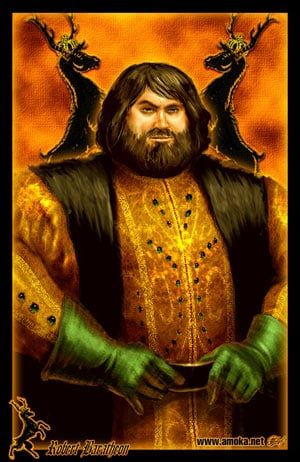
The full title of the King would go something like this: His Grace King Robert of House Baratheon, First of His Name, King of the Andals, Rhoynar, and the First Men, Lord of the Seven Kingdoms, and Protector of the Realm.

Credit to Amoka


Fairly straight forward right? I don't think so personally. Here we see the monarchic title as one which seems to merely bind diverse polities and peoples together, there is emphasis on the overlordship of the various peoples in the Seven Kingdoms and an emphasis on ruling all the different realms. There is of course the mention of the king as the supreme military leader and protector of the realm clearly indicating his military responsibility in the defense of the realm.

However, it seems to be lacking a number of things.

Firstly (and most obviously I think) it seems to lack any reference to the religious responsibilities or the favor of the dominant religion of Westeros the Faith of the Seven. Nowhere in his title does it mention the Faith, any religious obligation, or favor. Compare that to the title of the British monarch which explicitly states that the monarch rules 'By the Grace of God' and is 'The Defender of the Faith'. We do know that the monarch is crowned by the Faith and that they are anointed by the High Septon, but that gives us very little knowledge on what the mechanisms for the recognition of the Faith are (in fact we get perilous little information on the workings of the Faith of the Seven until A Feast For Crows).

Secondly despite the title of 'Lord of the Seven Kingdoms' there is a lack of acknowledgement over the King's personal authority of the Crownlands, which serves as the ruling Houses's personal demesne. Nowhere in the books do we really get an idea of how the king governs the Crownlands as its Lord Paramount, nor do we get a sense of what his duties are in ruling it. The lack of acknowledgement of this in the royal title is an oversight I think.

Finally there is an absence of mentioning how the King is the supreme justice in the realm. Yes it is implied as the right of the king and of course is in the law, but without it in the title, it is sincerely lacking I would say.

These are the great abscences I see in the royal title. Now If I were to have the King of Westeros's full title I would give it something like this: By the Light of the Seven, His Grace King Robert of House Baratheon, First of His Name, King of the Andals, Rhoynar, and the First Men, Lord of the Seven Kingdoms, Duke of the Crownlands, Supreme of Justice, Protector of the Realm, and Defender of the Faith.

Much more grandiose, but captures the full authority and duties as ruler of the Seven Kingdoms. Some would of course say that it is too unwieldy a title but I think for how grandiose titles could be in our time this one fits perfectly well!

Moving on to the next category I will be looking at the Lord's Paramount of Westeros, or as they are known the Great Houses.

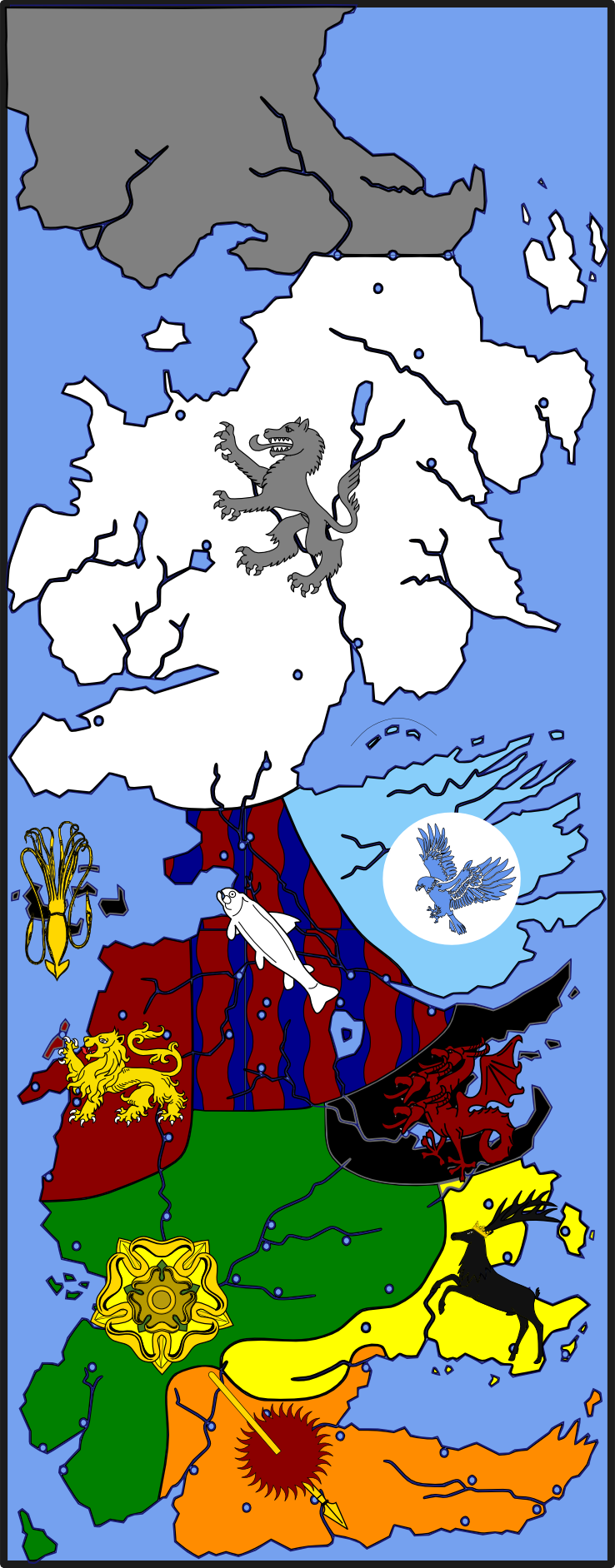
You have a Great House for each of the 8 separate realms of Westeros, each with differing amounts of power and prestige, and some having the added title of the Cardinal Wardens. There is only one mention of the Lord's Paramount in the book series though, and that is when discussing the removal of the Tully's as Lord's Paramount of the Riverlands. We are much more familiar with the discussion of the title of Warden and its implication, but more on that in a moment.

The Nine Regions of Westeros


The ruling Houses of these regions are the Great Houses of the realm, though this is rarely spelled out in detail but the implications and duties owed to them are often apparent. We also know that from the replacement of both House Tully and House Stark that this rank and title can be removed by royal decree and granted by such a decree. However it appears that it is a distinction which does not have to be renewed very often and seems to be one which has slowly become a fact of life in the realm and not one thought to be often challenged.

In light of both the power which is held by the Great Houses and their titles as Lord's Paramount I would propose that a good idea for GRRM had he given another noble ranking would have been to declare the Lord's Paramount Dukes. This not only gives them a clear rank above their other vassal houses, but adds to the de-facto hereditary position. This of course would still be subject to approval by the king and the removal of a house from power could be considered and enacted with ease, and that threat held above the Duke to ensure he doesn't get any ideas of rebelling.

Now the normal title of a Lord seems to go something like this: Eddard, Lord of Winterfell and Warden of the North. 

Now we can surmise that the title 'Lord of Winterfell' is the stand in for the title of Lord Paramount of the North since Winterfell is the de-facto capital of the Northern province. Much like Riverrun is the de-facto capital of the Riverlands and so forth. Unofficially it would seem that being lord of the capital is what encapsulates the ability to be Lord Paramount, but as we see when Petyr Baelish is declared Lord Paramount of the Riverlands and granted Harrenhall as his seat this is a concept which is fairly fluid and can apparently be changed at will. However, we also see the Frey who inherits Riverrun as mistakenly believing this elevates him to Lord Paramount of the Riverlands, which does show that tradition has handed down these great castles as the seats of power, but again, it appears to be a fluid institution.

Given the fluidity of the title I would personally propose it go something like this: Eddard, Duke of the North, Lord of Winterfell, Warden of the North (that last bit of course added on for accuracy).

This upgrades all the Lord's Paramount to the status of Dukes, gives themselves and their heirs an instantly recognizable social standing and higher authority over their vassals in a recognizable title. This would have helped balance things politically between the Lord's Paramount and their bannermen in many cases I feel as the authority and duties of a Duke over the whole of one of the regions of Westeros would grant them much more legitimacy and power.

The only regions I would see this distinction not working would be Dorne and the Iron Islands where the cultural differences would keep them from adopting such a title.

As a slight aside I would simply see the title of Warden, which is a purely military one, merely adding to the prestige of a Great House, and the reason it is sought after because it would potentially give them a degree of power over their social equals to command them as they saw fit.

Moving on let's examine the lesser houses and their titles. Here is somewhere where we would want to be more diverse in creating titles, but for simplicity I'm only going to suggest two distinctions. The two distinctions I would suggest are simply that between baron and lord. A baron would be a title of a greater lord who owns vast lands or is a much more wealthy house, and a regular lord would be one step above a knightly house.

The distinction is one I think is important for many reasons. Coming back to my question on the Frey's earlier, we can't know by title alone that House Frey is a younger house since its leader is named Lord just like every other noble in Westeros. I think it was a great opportunity that was missed in both narrative and sociopolitical terms to have Lord Walder Frey pining for both greater influence and a greater title. His House was one which was clearly rich, and strong, but being younger it didn't garner enough respect. I believe that the better driving motivation (and a clearer one) would have been Lord Walder to be wishing to become Baron Walder, since he clearly feels his house is on level with the Mallisters and even the Great Houses since he was so eager to gain marriage into one of them for his progeny.

So to put it in perspective I believe we would have had different addresses being doled out like this; let's say for a moment we are addressing Lord Jason Mallister of Seagard, with a baronial title he would most likely be styled Baron Seagard when addressed naturally and more formally as "My Lord Baron of Seagard" when addressed by his social inferiors. While addressing Walder Frey one would simply say, Lord Walder of the Twins, or more formally Lord Walder/Frey.

The fact that any lord would then have to address a baron more formally does two things in my eyes a) it establishes a balance of power between barons and their sworn houses (in regular Westeros parlance usually a lesser house or a knightly house being sworn to a more powerful house) which gives more of a degree of rank among them, and b) it has a better political aspect with Dukes having to worry more about their barons in the feudal politics ring and having a sure sign of rank and influence across the eight regions of Westeros.

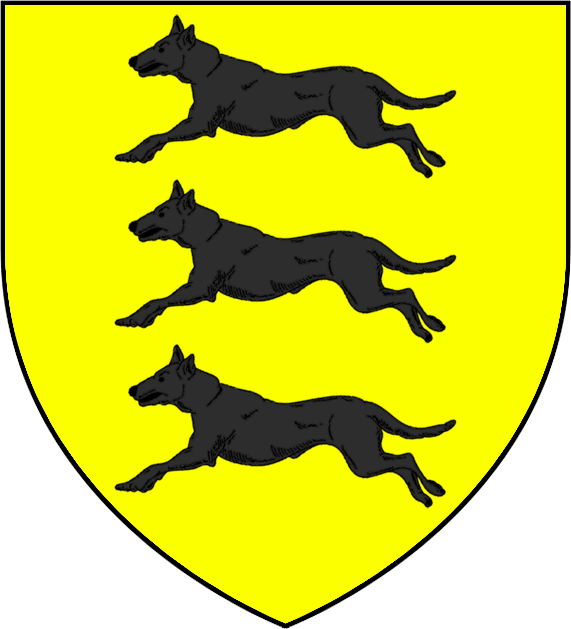
Now for the last noble title, a knightly house. These are the lowest order of nobility on the pecking order since they consist of landed knights with small holdings. Towerhouses and small holdfasts these are the lesser of the lesser lords. Not powerful enough to claim themselves as full lords, and more often than not simply the vassals of a larger house. They are valued for their military service and little else. This can be seen by Houses like House Clegane, House Cassel, and House Connington of Griffon's Roost.

House Clegane, the most infamous Knightly House


Personally I actually see nothing wrong with their naming and rank as it is and simply think that in my revised system the ranking becomes more clear and the power distinctions between the Houses of Westeros come into sharper focus giving us a better view into the feudal politics.

Now to summarize, here is how this new ranking system would work:

1) The Royal House (supreme rulers of the realm)

2) The 8 Ducal Houses (appointed by the king)

3) Baronial Houses (sworn as bannermen to the Ducal Houses)

4) Lordly Houses (either powerful enough but without the title to be sworn in as full bannermen or simply sworn vassals to Baronial houses)

5) Knightly Houses (basically landed knights and are sworn to whichever noble house which has granted them land)

There we have it. This is my own little fan reorganization of the nobility and titles of Westeros. I leave it to you to see if that makes sense or if it even works in your heads. I know it does in mine and that's how I'll stick with it!