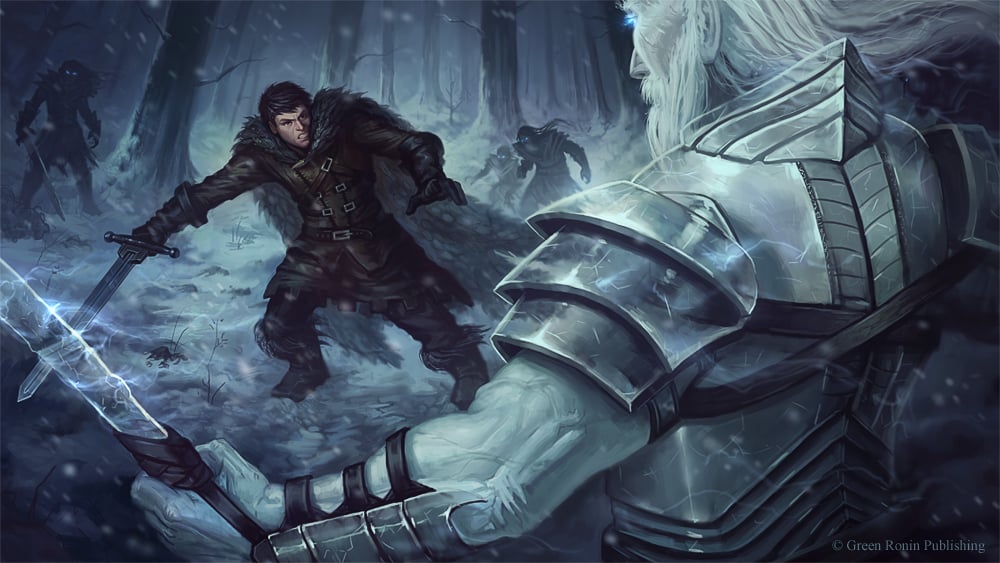
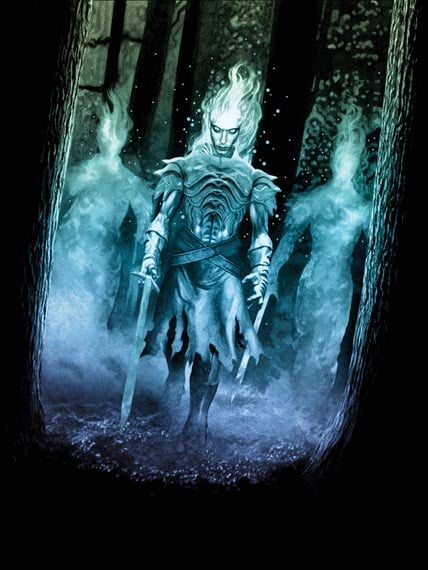
Synopsis: Bran, one of the younger sons of the Lord of Winterfell is present at the execution of a deserter of the Night's Watch, something which tragically ties up the tale of those poor Rangers and their meeting with the Others. There he see's his father do justice and it is explained to him why Ned had to kill the man himself. On their return journey to Winterfell they come across a troubling sign, a direwolf south of the Wall and with it just enough pups for the Stark children. Even one for the bastard Jon Snow.
 |
| Credit to Mark Evans |
What do we learn?
There are of course a number of things we can pick up on here, for convenience sake I shall break them down into their relevant categories.
Cultural:
This chapter is very interesting because it establishes almost immediately off the bat that the North is almost a cultural entity unto itself. We know of course from Westeros history that the North is both ethnically and culturally different from the southern realms with the culture of the First Men standing out in stark contrast to that of the Andals. Their customs, ideas, and traditions have survived countless attempts at integration into the southern realms and the Kings of Winter turned back countless Andal armies seeking to crush the last vestiges of the original culture of Westeros, it wasn't until dragons came that the last kingdom of the First Men finally joined the realm.
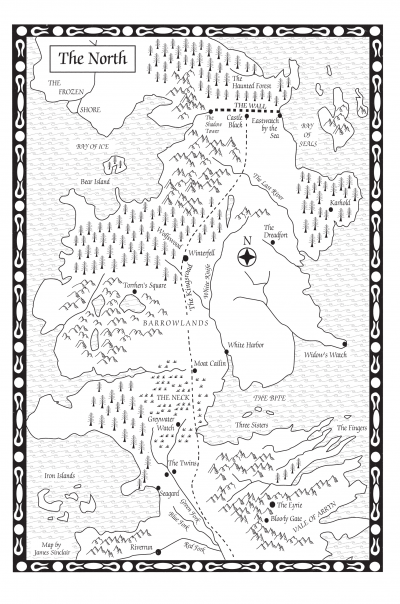 |
| The great North, one of the Seven Kingdoms |
Mind you this is established in a far more subtle way in this chapter. Here it's just shown as an act where the Lord of Winterfell believes that every man who passes the sentence should swing the sword, otherwise he loses sight of what it means to kill.
Philosophically this is a very noble tradition, and as Eddard points out, if a man has a headsman or someone to commit violence/justice on his behalf he soon loses any scope of what life or death means, even the concept of justice then becomes an abstract notion merely whim to the fancy of a monarch and not a hard decision which must be weighed according to the judge's conscience. Eddard here is unique as he acts as judge, jury, and executioner, though all in King Robert's name. More on that later.
This chapter also gives us a wee glimpse into the psyche of the Northmen who live there, even if only from the point of view of a nine year old lordling. However, he is seen here wondering after the wildlings, savage barbarians from beyond the Wall who come raiding and killing as they please, with only the Night's Watch, and eventually the Northern lords to stop them.
It gives us a good look at just how the wildlings are viewed south of the Wall. They are probably viewed in a more similar light to how the Chinese would have seen the barbarian riders from beyond the Great Wall than how the Romans would have seen Pictish tribesmen from beyond Hadrian's Wall. The culture differences between the two societies is interesting and will be fascinating to explore more in depth later on.
On a broader note we also get to see how contrary to some authors, GRRM keeps his medieval style peoples very much into omens and ill signs, much like people in our world would have been. The muttering about bad signs from the dire wolf, and the even worse sign of the stag's antler stuck in its throat is ominous for any reader, if they can pick up on it for their first read through.
Finally though we get our first look at the Night's Watch through the eyes of someone who isn't of the Night's Watch, a boy brought up on tales of the Others, giants, and wildlings, all the mysterious beings from beyond the Wall. Though beside that it is obvious he has been raised on tales of how the Night's Watch is a gallant organization, one which protects the realm. This will play an important part later on in the beginning of the series.
Lastly a brief word on deserters. Here we have the great quote from Lord Eddard Stark on deserters saying:
"In truth the man was an oathbreaker, a deserter from the Night's Watch. No man is more dangerous. The deserter knows his life is forfeit if he is caught, so he will not flinch from any crime no matter how vile."
There is of course wisdom in this and shows that Eddard knows of what he speaks when he muses on the nature of oathbreakers and deserters. We will be coming back to this train of thought quite a few times throughout the books and I encourage readers to ruminate on these words well.
Political:
One could be forgiven for thinking that there isn't much political about this chapter, but they would be incorrect. Right near the start we see some fascinating political developments in the forefront.
Firstly we get a glimpse at the power and responsibilities of the Lord Paramount of the North. It is clear that he is acting in the name of his King as when he goes to proclaim justice he invokes the name of the King with his full title. He also invokes his own authority as the Lord of Winterfell and the Warden of the North. Now we know that invoking the authority of the Warden of the North is meaningless since it is a purely military title with no other authority, but it is important to see he invokes his authority as Lord of Winterfell and as a Stark.
We can understand that the Starks have been overlords of the North for millennium (due in no small part to the strategic placement of Winterfell) and that the name Stark itself carries weight and authority in the North with great connotations. As Lord of Winterfell Eddard is expected to carry out the King's justice, defend his portion of the realm, and govern it as he sees fit. This is of course all subject to the laws of the realm set forth by Robert the king. Though as we will see later, the various feudal lords of Westeros have plenty of autonomy when it comes to dealing with things within their own domains.
Something that I think is often missed upon first reading is that the location of the execution and Eddard's words to Bran later show us something fascinating about feudal politics here. The holdfast that the execution is carried out in flies the banner of the Starks. This suggests either a) the banner was placed up to show Lord Eddard was in attendance, or b) that this is a holdfast held directly by the Starks and ruled from Winterfell.
I am more inclined to believe scenario b) based on Eddard's words to Bran here:
"One day, Bran, you will be Robb's bannerman, holding a keep of your own for your brother and your king,"I am inclined by this then to believe that this is a holdfast on a piece of land which is garrisoned or kept up by Stark retainers in service to their liege waiting for the day when a Stark heir will take his place as rightful lord of those lands and its attendant keep, where he will raise goods and swords for his brother and liege lord.
As looks into the feudal nature of the Seven Kingdom's go it is interesting, suggesting that at least some of the Great Houses hold tracts of land in trust for their heirs to help prevent wandering lords or dissension amongst their children, seeing that each is in some way compensated in land, which is only fitting for a person of their station.
Character:
As this is an early chapter it does show us some good first glimpses into the nature of the Stark boys, Eddard Stark, and his ward, Theon Greyjoy.
Since this is from the POV of Bran I may as well start with him, he is shown as being like any typical nine year old boy, afire with curiosity about the world and sitting in the shadow of his father and trying to live up to his expectations. Then of course he lives in the shadow of his brothers, even his half brother Jon Snow who is technically lesser than him in the social order, but is still regarded as a brother anyways.
Jon and Robb are shown as close, though we will later learn of course that rather than feel like brothers they are more like good friends since Jon is well aware of his bastard status and Robb is more outgoing and aggressive than his half brother. Like any young boy Robb is always up to no good and eager to speed along in life. We'll be getting a much better feel for these two as the series goes on.
Theon is also a character who we'll get more of a feel for but its interesting to see a few things. One is that despite being for all intents and purposes a hostage, Lord Eddard treats him as, essentially, an equal to his sons, he is allowed to accompany them on matters of the kings justice, see the authority of the Lord of Winterfell carried out, carry weapons, and ride amongst the noble party as an equal. He is not well liked however, and Jon mutters that he is an ass and a bloody minded boy, arrogant and quick to laugh. We can in fact tell that Jon doesn't like him very early on, the other Starks though are far more accepting of him.
Finally we get Lord Eddard Stark himself. From the POV of Bran we see a mighty and imposing man, one who has dual personalities which Bran refers to as 'Father' and 'The Lord of Winterfell' showing us that Eddard takes both his responsibilities as the head of House Stark, and the Lord of the North seriously, but handles them with a different personality. As a father he is a concerned, caring, and deeply emotional man, but as the Lord of the North he is a stern, hard, and dutiful man who works hard to do his duty.
Contrary to what many believe about Ned being stupid, he is actually a smart, decisive and fairly skilled political actor. As the review goes on I plan to show how events (and GRRM) conspired against him in the Game of Thrones and that while he was a great player who was bound by honor, he did indeed make mistakes but never lost because of it, but rather, in spite of it.
However, more on that another time.
General:
Well here we see the end of our poor friend Gared. Clearly driven mad by the events he witnessed on his ranging, the ranger simply ran blind with fear from the otherworldly menace that was the Others and attempted to get as far away as possible.
We also once again get a beautiful point of dramatic irony as Bran is curious and even a bit eager to believe the fantastic stories from beyond the Wall, but his elders who are more level headed (tragically) are disinclined to believe in such fanciful tales.
Yet another wonderful interaction with the meta-plot of the series is the finding of the direwolf and her cubs. This is once more a very fleeting glimpse into the fantastical elements of the series with the direwolf just happening to perish in a place where the pups can be found by children who all just happen to have inherited warging abilities.
The cool meta-plot material here is clearly showing us that something is stirring beyond the Wall and even though one force is evil, another force which is good (or 'good' in the sense that the Old Gods/Greenseers are at least opposed to the life destroying will of the Others) is attempting to push back and set up a way for them to be defeated.
How this is to be is of course left to our imaginations but I have thoughts of my own on the subject I may share later on in this series.
As another aside I feel compelled to end the analysis by praising the way that the TV show handled this scene. It captured the character of Eddard Stark and his children well and did a wonderful job of showing us both the unfairness of the Seven Kingdoms, and how hard the North is.
For your consideration: